.avif)

Procurement is becoming more complex as businesses deal with supplier risk, cost pressure, fragmented spend, and technology change. Deloitte’s 2025 Global CPO Survey gathered input from more than 250 CPOs across 40 countries and found that procurement leaders are managing rising complexity from supply chain disruption, regulation, and AI-led transformation.
For UAE businesses, this makes procurement classification more than a textbook exercise. Buying inventory, renewing software, hiring a service provider, or investing in equipment should not follow the same workflow. Each type of procurement carries a different level of financial risk, operational dependency, and documentation needs.
Understanding the types of procurement helps businesses choose the right approval process, supplier evaluation method, and finance control level for each spending category.
In this blog, we will break down the different types of procurement, the procurement techniques used in each case, and how businesses can choose the right method to balance speed, control, and financial visibility.
TL;DR / Key Takeaways
- Procurement types define what the business is buying, while procurement methods define how suppliers are selected and purchases are executed.
- Direct, indirect, goods, services, and capital procurement each carry different levels of operational and financial risk.
- Applying the same procurement process to every purchase either slows down routine spend or under-controls strategic spend.
- Services procurement needs stronger scope definition and invoice validation because outputs are harder to measure than physical goods.
- Strong procurement control depends on matching the spend type with the right approval workflow, supplier evaluation method, and documentation standard.
What Procurement Types Actually Mean
Procurement can be classified in different ways, but most businesses group it into a small set of core categories. These categories help determine how structured the procurement process needs to be and what level of oversight is required.
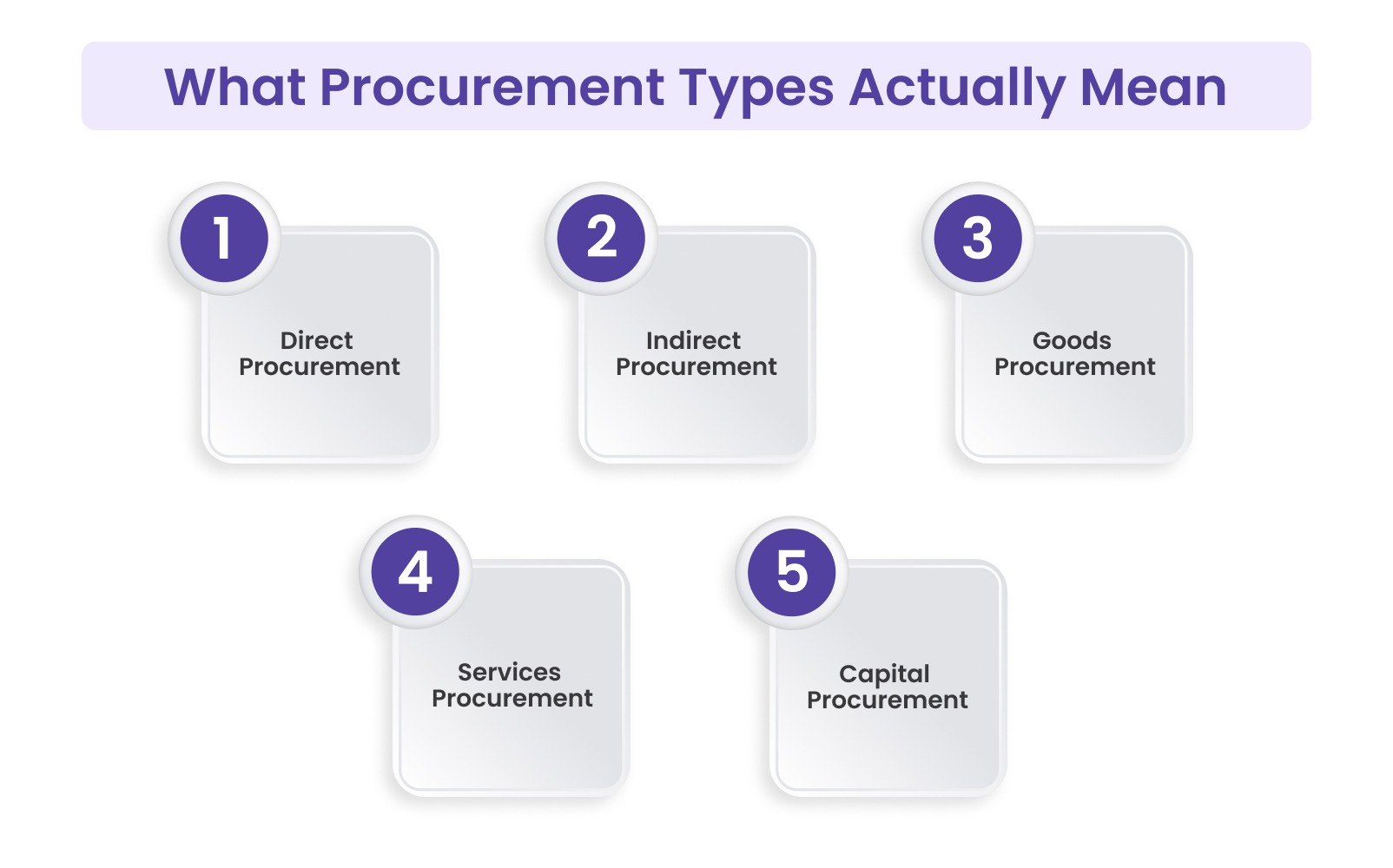
Understanding these types is useful because each one creates different challenges for procurement and finance teams. Some require detailed supplier evaluation and long-term planning, while others need faster execution with lighter controls.
CIPS separates procurement into categories such as direct procurement, where goods and materials go into production, and indirect procurement, where purchases support day-to-day operations, which is why the same process should not be applied to every spend type.
1. Direct Procurement
Direct procurement refers to the purchase of goods and materials that are directly used in producing a company’s core product or service. For example, a manufacturing company sourcing raw materials or a retailer purchasing inventory for resale.
This type of procurement has a direct impact on revenue and margins. Any disruption in supply or change in pricing can affect production timelines and profitability. As a result, supplier selection, contract terms, and continuity planning become critical.
2. Indirect Procurement
Indirect procurement covers purchases that support business operations but are not directly tied to production. This includes office supplies, software subscriptions, utilities, marketing services, and administrative expenses.
While each transaction may be smaller, indirect procurement often involves a large number of suppliers and frequent purchases. This creates challenges around visibility, vendor control, and policy enforcement.
Also Read: Indirect Spend Analysis Management Guide
3. Goods Procurement
Goods procurement focuses on purchasing physical items, whether they are used for production or operational purposes. This includes inventory, equipment, and consumables.
The key challenge here is balancing availability with cost. Holding too much inventory ties up cash, while insufficient stock can disrupt operations. Procurement decisions need to consider demand patterns, storage costs, and supplier reliability.
4. Services Procurement
Services procurement involves engaging third-party providers for work that cannot be standardised in the same way as goods. This includes consulting, maintenance, marketing, IT services, and professional support.
Unlike goods, services are often harder to measure and verify. This makes scope definition, performance tracking, and invoice validation more complex. Approval discipline becomes important to ensure that services delivered match what was agreed.
5. Capital Procurement
Capital procurement refers to high-value purchases that are intended for long-term use, such as machinery, vehicles, or major infrastructure investments.
These decisions usually involve longer evaluation cycles, multiple stakeholders, and stronger financial scrutiny. The focus is not just on cost, but on return on investment, lifecycle value, and long-term impact on operations.
Why Different Procurement Types Need Different Controls
Not all procurement carries the same level of risk or complexity. Applying a single workflow across all categories often leads to inefficiencies or control gaps.
Direct procurement requires tighter supplier management and continuity planning. Indirect procurement needs stronger visibility and policy enforcement due to volume and frequency. Services procurement demands clearer approval structures because outputs are less standardised. Capital procurement requires detailed evaluation and long-term planning.
When these differences are ignored, businesses either overcomplicate routine purchases or under-control high-impact spending. The goal is to align the level of process with the nature of the procurement type.
The Main Procurement Methods Businesses Use
While procurement types define what is being purchased, procurement methods define how suppliers are selected and how the purchase is executed. These methods vary based on cost, urgency, complexity, and risk.
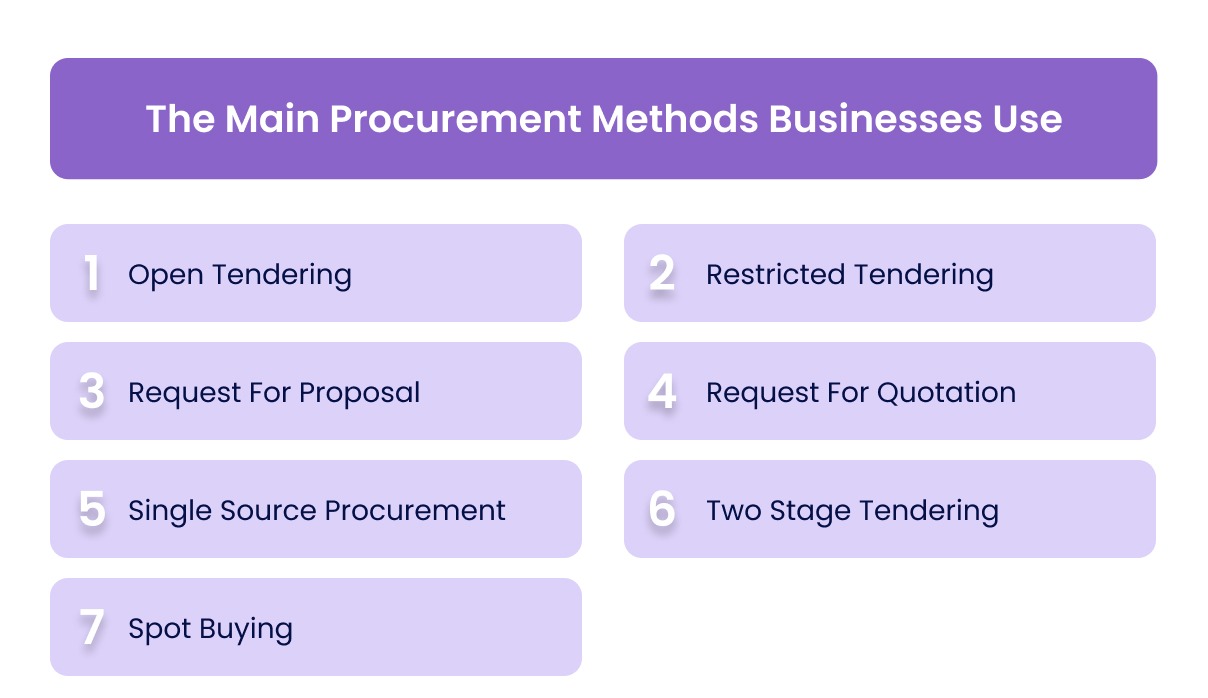
1. Open Tendering
Open tendering allows any qualified supplier to submit a bid. It is commonly used for large or regulated purchases where transparency is important.
This method ensures competitive pricing and fairness, but it can be time-consuming due to the volume of responses and evaluation effort required.
2. Restricted Tendering
Restricted tendering limits participation to a shortlist of pre-qualified suppliers. This reduces evaluation effort while maintaining a level of competition.
It is useful when the business already has a defined pool of reliable vendors.
3. Request For Proposal
A request for proposal (RFP) is used when the requirement is complex and cannot be defined purely on price. Suppliers are asked to submit detailed proposals covering approach, capability, and pricing.
This method is common in services procurement and strategic supplier selection.
4. Request For Quotation
A request for quotation (RFQ) is used when specifications are clear and the primary comparison factor is price. Suppliers provide quotes based on predefined requirements.
This method is faster than RFPs and works well for standardised purchases.
5. Single Source Procurement
Single source procurement involves selecting one supplier without a competitive process. This may happen when a supplier offers unique capabilities or when continuity is critical.
While efficient, it requires strong justification and oversight to avoid over-reliance or pricing risk.
6. Two Stage Tendering
Two-stage tendering allows initial proposals to be submitted before final specifications are confirmed. The process is refined in stages before the final contract is awarded.
This method is useful for complex projects where requirements evolve over time.
7. Spot Buying
Spot buying refers to one-off purchases made outside long-term supplier agreements. It is often used for urgent or low-value needs.
While flexible, excessive reliance on spot buying can reduce control and increase costs over time.
Which Procurement Methods Fit Which Procurement Type
Choosing the right procurement method becomes easier when it is aligned with the type of spend. The same method does not work equally well across all categories, and mismatches are one of the main reasons procurement processes either slow down or lose control.
1. Direct Procurement Usually Requires Structured Supplier Evaluation
Direct procurement affects production, delivery timelines, and margins. As a result, it typically relies on more structured methods such as restricted tendering, RFPs, or long-term supplier negotiations.
These methods allow businesses to evaluate suppliers on reliability, pricing stability, and capacity, not just cost. A rushed or loosely structured approach in this category can create downstream operational risk.
2. Indirect Procurement Benefits From Simpler And Faster Methods
Indirect procurement tends to be frequent and distributed across teams. Using heavy tendering processes for routine purchases slows the business down without adding meaningful value.
Simpler methods such as RFQs, approved supplier lists, and controlled spot buying are more effective here. The focus should be on maintaining visibility and enforcing policy rather than over-engineering each purchase.
3. Services Procurement Needs Clear Scope And Evaluation Discipline
Services procurement often relies on RFPs or negotiated procurement because the output cannot be standardised in the same way as goods.
The key requirement is clarity. Scope definition, deliverables, and pricing structures must be clearly documented before approval. Without that, invoice validation becomes difficult and disputes are more likely.
4. Capital Procurement Requires Formal And Multi Stage Processes
Capital purchases involve higher financial commitment and longer-term impact. Methods such as open tendering, restricted tendering, or two-stage tendering are commonly used to ensure proper evaluation and stakeholder alignment.
These processes may take longer, but they provide the level of scrutiny needed for high-value decisions.
How Procurement Type Shapes Finance Risk
The type of procurement directly influences how financial risk appears across the organisation. It affects how easily transactions can be validated, how predictable spending is, and how much manual intervention is required from finance teams.
Direct procurement introduces supplier dependency risk and requires strong contract alignment. Indirect procurement creates volume-driven risk, where many small transactions reduce visibility and increase the chance of policy breaches. Services procurement introduces ambiguity, making it harder to verify whether invoices reflect actual delivery. Capital procurement concentrates risk into fewer but larger decisions.
From a finance perspective, these differences affect:
- Approval Design and how decisions are reviewed before commitment
- Invoice Validation Complexity depending on how measurable the purchase is
- Spend Visibility across teams, suppliers, and categories
- Audit Readiness based on documentation quality and traceability
Also Read:
Common Mistakes When Businesses Classify Procurement Poorly
Procurement classification is often treated as a theoretical exercise, but in practice, it has a direct impact on how well procurement is controlled. When categories are not defined properly, the process tends to break down in predictable ways.
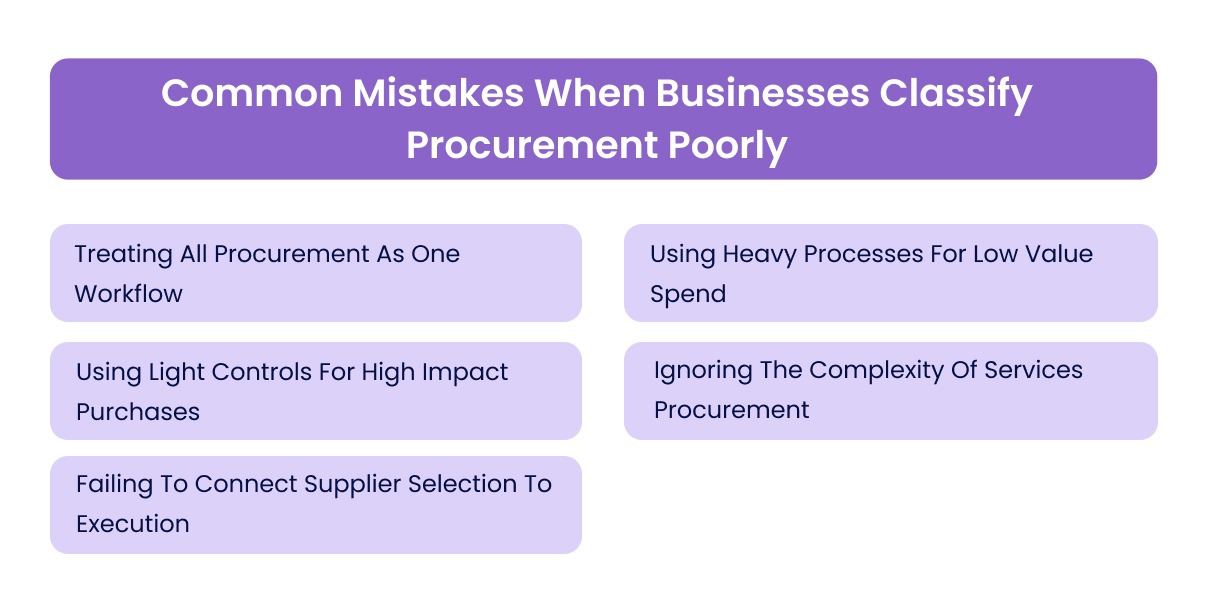
1. Treating All Procurement As One Workflow
Applying the same approval and sourcing process across all types of spend creates inefficiencies. Routine purchases become unnecessarily slow, while strategic purchases may not receive the level of scrutiny they require.
2. Using Heavy Processes For Low Value Spend
Overusing tendering or complex evaluation methods for small or routine purchases slows teams down and increases administrative effort without improving outcomes.
3. Using Light Controls For High Impact Purchases
At the other end, applying minimal structure to high-value or critical procurement decisions increases the risk of poor supplier selection, pricing issues, and operational disruption.
4. Ignoring The Complexity Of Services Procurement
Services procurement is often treated like goods procurement, even though it requires different evaluation and validation approaches. This leads to unclear deliverables and invoice disputes.
5. Failing To Connect Supplier Selection To Execution
Even when supplier selection is structured, businesses often lose control during ordering, invoicing, and payment. This disconnect leads to contract leakage and weak financial oversight.
Where Procurement Breaks Down In Practice
Most procurement challenges do not come from the absence of a process. They come from gaps between stages. A supplier may be selected correctly, but approvals are bypassed. Purchase orders may be issued, but invoices arrive outside the system. Payments may be made, but documentation is incomplete.
These gaps create recurring issues such as:
- off-contract purchases
- maverick spend
- fragmented supplier records
- delayed invoice approvals
- increased reconciliation effort
These are not isolated problems. They are symptoms of procurement processes that are not fully connected.
Related:
- What Is Maverick Spending And How To Control It
- Tail Spend Management Procurement
- Understanding Purchase Requisition Importance
How Alaan Supports Procurement Control After Supplier Selection
Once a procurement decision is made, the focus shifts from selection to execution. This is where many businesses lose control, especially when approvals, payments, and documentation are handled across disconnected systems.
At Alaan, we focus on strengthening this execution layer so that procurement decisions translate into controlled and visible spending.
- Corporate Cards With Spend Controls And Vendor Restrictions
We allow businesses to issue corporate cards with defined limits and merchant-level restrictions, helping ensure that purchases stay within approved boundaries. - Structured Approval Workflows Before Spend Happens
Expenses can be routed through configurable approval flows, so procurement-related spend is reviewed before it occurs. - Real Time Visibility Into Procurement Spend
Finance teams can track spending by supplier, category, and team as it happens, reducing reliance on end-of-month reporting. - Centralised Invoice And Receipt Capture
All supporting documents are linked to transactions, improving verification and reducing fragmented records. - Cleaner Reconciliation And Accounting Sync
With integrations into systems like Xero, QuickBooks, NetSuite, and Microsoft Dynamics, procurement spend flows into accounting with minimal manual effort. - Better Audit Readiness Across Transactions
Each transaction carries a clear trail of approvals, documentation, and categorisation, improving compliance and audit outcomes.
Procurement control should not stop at selecting the right supplier. It needs to extend through ordering, invoicing, and payment, where financial risk is highest.
Also Read:
- Procure To Pay Systems Process Steps
- Procurement Automation Software Solution
- Guide To Manage Overall Business Spending
Conclusion
Understanding the types of procurement is not just about classification. It is about recognising that different types of spend require different levels of structure, control, and evaluation.
When procurement methods are aligned with the nature of the purchase, businesses can move faster on routine spend while maintaining discipline on high-impact decisions. This balance improves supplier outcomes, reduces leakage, and makes financial oversight more reliable.
If you want to strengthen how procurement decisions translate into controlled spending, you can explore how Alaan helps finance teams maintain visibility, enforce approvals, and keep procurement-related transactions fully aligned from purchase to reconciliation. Book a Demo Today!
Frequently Asked Questions
1. What Are The Main Types Of Procurement
The main types of procurement include direct procurement, indirect procurement, goods procurement, services procurement, and capital procurement. Each type reflects a different category of business spending.
2. What Is The Difference Between Procurement Types And Procurement Methods
Procurement types refer to what a business is buying, while procurement methods refer to how suppliers are selected and how purchases are executed.
3. Which Procurement Method Is Best For Services Procurement
Services procurement typically works best with methods such as requests for proposals or negotiated procurement, where suppliers are evaluated based on expertise, approach, and pricing.
4. Is Indirect Procurement Harder To Control Than Direct Procurement
Indirect procurement can be harder to control because it involves many smaller transactions across multiple teams, making visibility and policy enforcement more challenging.
5. When Should A Business Use Single Source Procurement
Single source procurement is used when a supplier offers unique capabilities, when continuity is critical, or when switching suppliers would create significant disruption.
6. How Do Procurement Types Affect Invoice And Payment Control
Different procurement types create different levels of complexity in invoice validation and payment control. For example, services procurement may require more detailed verification, while goods procurement may rely more on matching purchase orders with invoices.