.avif)


A business can grow, report profit, and still come under serious financial pressure if cash is not available when obligations fall due. That is why the importance of liquidity management goes far beyond treasury theory. It sits at the centre of whether payroll runs on time, suppliers stay confident, tax obligations are met, and management can make decisions from a position of control rather than urgency. In the UAE context, the distinction matters sharply: profit reflects earning capability, while cash flow reflects short-term financial strength, and businesses that treat the two as interchangeable expose themselves to avoidable liquidity risk.
Liquidity pressure rarely announces itself through one dramatic event. It usually builds through timing gaps. Receivables stretch, fixed outflows remain fixed, inventory absorbs more cash than expected, or discretionary spend continues without a clear view of what is already committed. By the time the problem becomes visible in daily operations, the business is no longer managing liquidity. It is reacting to it. A shortage of cash reserves or restricted access to funding can prevent a business from meeting financial obligations and lead directly to operational disruption.
This article looks at why liquidity management matters in real operating businesses, why profit is often the wrong comfort metric in the short term, and how cash flow management helps in liquidity by improving visibility, timing, and control before pressure turns into a crunch.
TL;DR / Key Takeaways
- Liquidity management matters because a business can be profitable and still come under financial pressure if cash is not available when obligations fall due.
- Timing gaps usually create liquidity problems faster than moderate weakness in margins or reported profit.
- Cash flow management helps in liquidity by improving forecast visibility, tightening collections, sequencing outflows, and protecting cash optionality earlier.
- Strong liquidity discipline depends on more than reserves. It also depends on working capital control, scenario planning, and faster visibility into committed spend.
- Alaan helps finance teams strengthen liquidity discipline through approvals, spend visibility, controlled corporate cards, and cleaner transaction records.
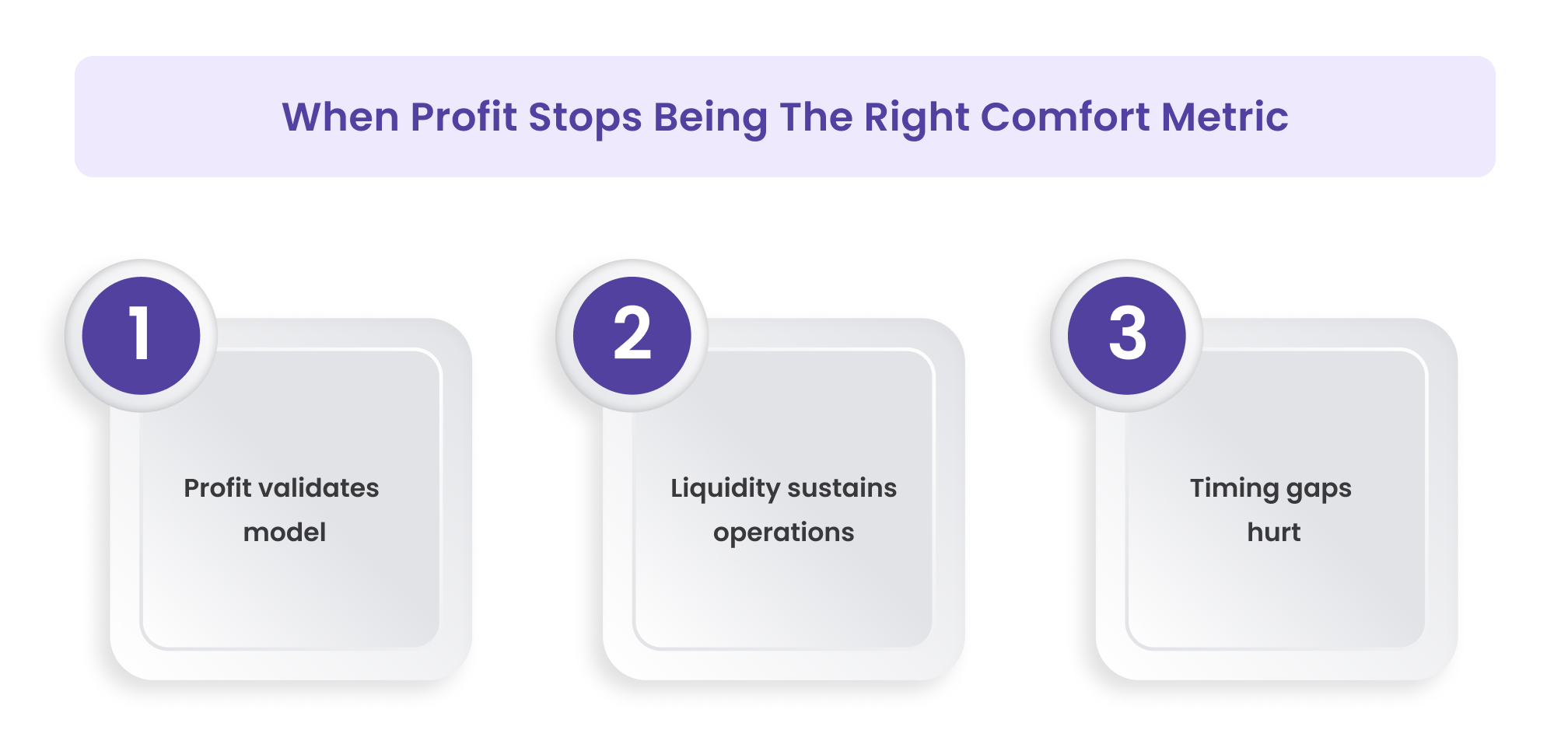
When Profit Stops Being The Right Comfort Metric
One of the most common finance mistakes is treating profitability as proof of near-term financial safety. It is not. Profit tells you whether the business model is generating value over a period. Liquidity tells you whether the business can keep moving right now.
That distinction becomes critical when timing turns against the business. Revenue may already be recognised, but collections may still be delayed. Margins may still look acceptable, but payroll, rent, debt servicing, and supplier obligations do not wait for receivables to catch up. This is why a business can look commercially healthy and still experience financial strain. In the UAE examples highlighted by finance advisers, businesses that understand the difference between cash flow and profitability are better positioned to manage liquidity risk because they stop relying on accounting comfort where cash timing is the real issue.
Profit Tells You Whether The Model Works
Profit remains important. It tells management whether pricing, cost structure, and overall performance are moving in the right direction. But it is still a period measure. It does not automatically tell you whether cash is available at the exact points where obligations must be met.
Liquidity Tells You Whether The Business Can Keep Moving
Liquidity is more immediate. It answers whether the business has enough accessible cash, or enough control over near-term inflows and outflows, to continue operating without stress. That is why liquidity problems tend to feel operational long before they look catastrophic in financial statements.
Timing Gaps Hurt Faster Than Margin Weakness
A margin problem often gives management time to respond. A liquidity problem often does not. If collections slow while outflows remain fixed, pressure reaches payroll, suppliers, and compliance obligations quickly. In practice, timing gaps can damage decision quality faster than a moderate decline in profitability because management starts prioritising immediate survival over controlled execution.
Related: Cash flow operating activities guide
Why The Importance Of Liquidity Management Shows Up Under Pressure
Liquidity management matters most when the business loses the luxury of perfect timing. That is when strong finance teams separate themselves from reactive ones.
Payroll, Suppliers, And Statutory Payments Do Not Wait
Some obligations are inflexible. Salaries, supplier settlements, rent, loan payments, and tax commitments do not pause because collections have slowed. When liquidity is weak, management is forced into trade-offs it should not be making at that stage.
Growth Can Create Liquidity Stress, Not Just Weak Performance
Liquidity pressure is not always a sign of decline. Growth can produce it too. More sales can mean more working capital absorbed into receivables, inventory, onboarding costs, and expansion commitments before the cash cycle catches up. That is why liquidity discipline matters in scaling businesses just as much as in distressed ones.
Liquidity Gives Finance Teams Room To Decide, Not Just React
The real value of liquidity management is optionality. It gives finance time to decide how to sequence payments, when to preserve cash, where to tighten spend, and whether to adjust forecasts before the business is forced into defensive moves. Without that room, even routine decisions become pressure decisions.
Also read: Cash flow optimisation strategies and techniques
The First Places Liquidity Strain Usually Appears
Liquidity strain usually becomes visible in patterns before it becomes visible in crisis.
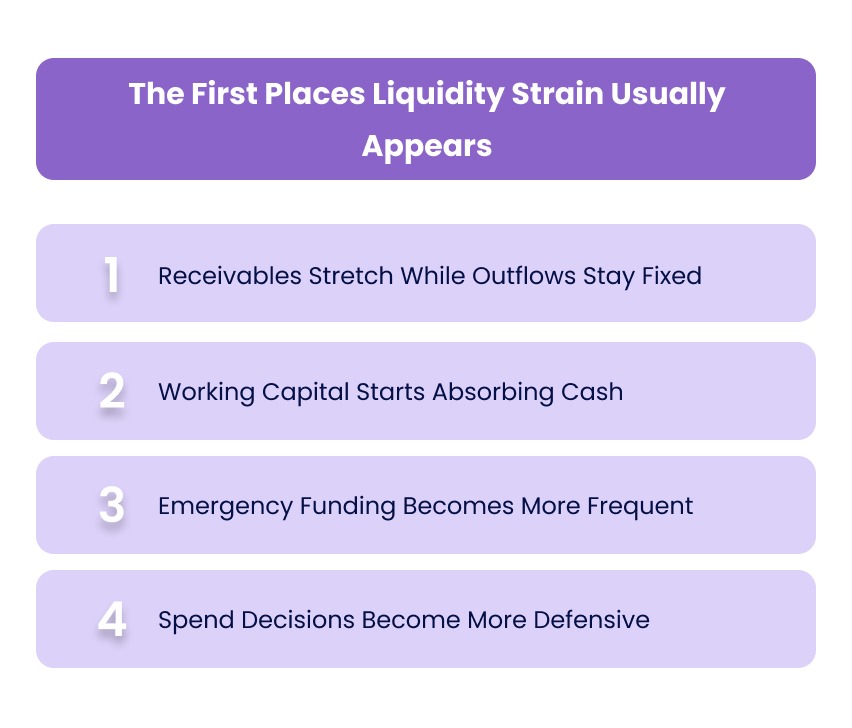
Receivables Stretch While Outflows Stay Fixed
One of the earliest warning signs is a widening gap between when the business earns revenue and when it actually receives cash. Meanwhile, payroll, rent, taxes, and supplier commitments continue on schedule.
Working Capital Starts Absorbing Cash
Inventory, prepayments, and operational build-up can quietly lock up cash that management assumed was still available. The business may still be trading actively, but flexibility starts shrinking.
Emergency Funding Becomes More Frequent
When businesses repeatedly rely on short-term fixes to bridge routine obligations, that is usually a liquidity-management signal, not an isolated timing issue.
Spend Decisions Become More Defensive
Teams start delaying purchases, renegotiating urgent payments, or holding back on projects not because strategy changed, but because cash visibility weakened. Once that happens, liquidity has already started to shape operations.
Related: Essential guide to spend mapping analysis
How Cash Flow Management Helps In Liquidity
Liquidity does not improve through awareness alone. It improves when finance can see cash movement early enough to influence outcomes before pressure hardens into constraint. That is where cash flow management helps in liquidity. It gives the business a working view of timing, not just a record of what has already happened.
Forecasting Makes Timing Visible
A rolling cash forecast is one of the simplest ways to strengthen liquidity discipline. It shows when receivables are expected to land, when obligations bunch up, and where shortfalls may emerge if nothing changes.
That visibility matters because most liquidity problems are not caused by one large surprise. They come from several timing gaps landing at once. When finance can see those points early, it can adjust payment timing, tighten collections focus, defer non-essential outflows, or preserve liquidity before the pressure becomes operational.
Collections Discipline Protects Liquidity Faster Than Revenue Growth
Revenue growth helps over time. Collections discipline helps sooner.
When receivables are allowed to drift, the business may look active and commercially healthy while near-term liquidity weakens underneath. Strong collections follow-up, tighter invoice discipline, and earlier escalation on overdue balances often improve liquidity faster than trying to solve the problem through new sales alone. That is especially relevant in businesses where customer payment cycles stretch while salary, rent, and supplier outflows remain fixed.
Supplier-Term Management Reduces Short-Term Pressure
Liquidity management is not only about accelerating inflows. It is also about managing outflows with more control.
That means understanding which suppliers are strategic, which obligations are inflexible, and where payment terms can be structured more intelligently without weakening supplier trust. Finance teams that manage supplier timing deliberately usually preserve more flexibility than those that treat all outflows as equally urgent.
Spend Control Preserves Cash Optionality
A business rarely loses liquidity only because revenue slowed. More often, it loses liquidity because outflows kept moving without enough control while visibility weakened.
That is why cash flow management helps in liquidity through spend discipline as much as through forecasting. Better approval control, earlier visibility into committed spend, and tighter review of discretionary outflows all help protect cash optionality when conditions tighten.
Cash Buffers Reduce Shock Risk
No forecast removes uncertainty entirely. Delayed customer payments, project slippage, tax obligations, and sudden supplier demands can still disrupt expected timing.
That is why strong liquidity management usually includes some form of reserve thinking. The point is not to hold idle cash unnecessarily. It is to avoid operating at a level where one timing disruption forces the business into emergency decision-making.

What Strong Liquidity Management Looks Like In Practice
Strong liquidity management is rarely dramatic from the outside. It shows up in the absence of preventable pressure. Payroll runs without last-minute stress, suppliers are managed with confidence, tax obligations do not arrive as surprises, and management can make trade-offs from a position of control.
In practice, that usually means:
- Rolling Cash Visibility
Finance is working with a current view of expected inflows, outflows, and timing risk rather than relying on static monthly reporting. - Clear Priority Of Obligations
The business knows which payments are fixed, which are strategic, and which can move without damaging operations. - Tighter Working Capital Discipline
Receivables, inventory, supplier terms, and short-term commitments are managed actively instead of being reviewed only after pressure appears. - Scenario Planning For Shortfalls
Finance can model what happens if receivables slip, costs rise, or planned inflows do not land on time. - Controlled Discretionary Spend
Non-essential outflows do not continue automatically when liquidity conditions change. - Faster Decision-Making Under Pressure
The finance team can act early because it already has the information needed to prioritise, defer, or escalate.
This is what makes the importance of liquidity management so practical. It is not just about maintaining a cash balance. It is about preserving operating control.
Related: Difference between budgeting and financial forecasting
Liquidity Discipline Is Also A Spend-Control Discipline
Liquidity pressure is often discussed as though it begins in receivables or funding access alone. In reality, it is also shaped by how spending moves through the business.

A finance team can forecast well and still lose liquidity control if outflows are poorly governed. That is why liquidity discipline is not only a treasury task. It is also a spend-control task.
Weak Spend Visibility Distorts Liquidity Planning
When finance cannot see committed spend clearly, cash planning becomes less reliable. The problem is not only what has already been paid. It is what has already been approved, promised, or effectively committed but is still missing from a usable cash view.
This is one reason liquidity issues often feel sudden. The outflow may not actually be new. It may simply have been invisible until too late.
Poor Approval Hygiene Creates Cash Surprises
Loose approval processes create more than policy risk. They create liquidity risk.
If purchases are approved informally, if emergency spend bypasses the normal workflow, or if teams commit to vendors before finance sees the obligation, cash leaves the business faster than management expects. That weakens the ability to sequence payments intelligently.
Finance Needs Faster Visibility Into What Is Already Committed
The real advantage in strong liquidity management is not only knowing the bank balance. It is knowing what the business has already set in motion.
That includes approved spend, expected vendor payments, reimbursable activity, recurring obligations, and discretionary outflows that may still be stoppable. The earlier finance sees those commitments, the more room it has to protect liquidity without making blunt cuts later.
Also read: Understanding spend visibility and business benefits
How Alaan Helps Finance Teams Protect Liquidity Through Better Spend Control
Liquidity weakens when cash leaves the business with limited timing visibility, weak approval discipline, or fragmented supporting records. That is why stronger spend control is not separate from liquidity management. It is part of it.
Alaan helps finance teams tighten that layer through approval workflows, controlled cards, real-time spend visibility, receipt and invoice capture, and accounting integrations that keep outflows easier to track and reconcile.
- Approval Workflows Before Spend Happens
Approval workflows help businesses review spend before money moves, which reduces the number of outflows that surprise finance after commitment. That makes short-term cash planning more accurate and gives teams better control over discretionary spending. - Real-Time Visibility Into Outflows
Real-time visibility into company spend helps finance see where cash is moving across teams, categories, and suppliers. That improves liquidity awareness because management is working with current outflow information rather than retrospective reporting alone. - Corporate Cards With Controlled Limits
Controlled corporate cards make it easier to define spending boundaries in advance rather than trying to clean up outflows afterward. That is especially useful when finance wants to preserve cash flexibility without slowing routine business activity unnecessarily. - Receipt And Invoice Capture
When receipts and invoices stay attached to transactions, finance gets a cleaner view of why cash moved, when it moved, and how it should be recorded. That reduces documentation gaps and supports more reliable cash oversight. - Cleaner Reconciliation Through Accounting Integrations
Integrations with systems such as Xero, QuickBooks, Oracle NetSuite, and Microsoft Dynamics help transactions flow into accounting more cleanly, reducing manual lag and making liquidity analysis easier to trust.

Conclusion
The importance of liquidity management becomes obvious when timing turns against the business. Profit may still look healthy, sales may still be growing, and the operating model may still be viable, but if cash is not available when obligations fall due, management loses flexibility quickly.
That is why liquidity management matters. It protects continuity, preserves decision quality, and gives finance teams room to act before pressure becomes disruption. Strong liquidity management is rarely just about holding more cash. It is about understanding timing risk, tightening working capital discipline, and improving control over how money leaves the business.
And because outflows are a major part of that equation, liquidity discipline is also a spend-control discipline. Alaan helps finance teams strengthen that layer through approvals, spend visibility, controlled cards, and cleaner reconciliation across the business. Book a demo to see how Alaan helps turn better spend control into stronger liquidity discipline.
FAQs
1. Why Is Liquidity Management Important For A Business?
Liquidity management is important because it determines whether a business can meet near-term obligations on time. That includes payroll, suppliers, tax payments, rent, debt servicing, and other operating commitments. Without strong liquidity control, even profitable businesses can come under pressure.
2. How Does Cash Flow Management Help In Liquidity?
Cash flow management helps in liquidity by improving visibility into when money is expected to come in and when it needs to go out. That helps finance teams forecast shortfalls earlier, tighten collections, manage payment timing, and preserve cash before pressure becomes disruptive.
3. Can A Profitable Business Still Face Liquidity Problems?
Yes. A business can report profit and still face liquidity problems if receivables are delayed, working capital absorbs too much cash, or outflows remain high while collections slow. Profit measures performance over a period. Liquidity measures cash availability in the near term.
4. What Causes Liquidity Pressure In Growing Businesses?
Growth often creates liquidity pressure when revenue expands faster than cash collections, inventory increases, onboarding costs rise, or supplier and payroll obligations grow before inflows catch up. Growth can therefore create funding strain even when commercial performance looks strong.
5. What Is The Difference Between Liquidity Management And Cash Flow Management?
Liquidity management is the broader discipline of maintaining enough accessible cash or cash flexibility to meet obligations. Cash flow management is one of the main ways to support it, through forecasting, collections, payment planning, and control over inflows and outflows.
6. How Can Finance Teams Improve Liquidity Without Cutting Growth Completely?
Finance teams usually improve liquidity faster by tightening collections, improving forecast visibility, sequencing outflows better, controlling discretionary spend, reviewing working capital discipline, and strengthening approval control over committed spend before making blunt cuts to growth activity.