.avif)


In UAE businesses, exchange exposure rarely appears as a standalone treasury issue. It usually enters through ordinary commercial activity: supplier contracts priced in euros, customer invoices raised in pounds, subscriptions billed in dollars, or group balances that need to be translated at month-end. The underlying business decision may be sound, yet the final financial outcome can still shift once currency movement starts affecting settlement values, cash planning, or reported margins.
That risk becomes more relevant as cross-border activity grows. The UAE’s non-oil foreign trade reached AED 3 trillion in 2024, reflecting how deeply many businesses now operate across international suppliers, customers, and payment flows. At the same time, while the dirham’s peg to the US dollar reduces one layer of volatility, it does not remove exposure to other trading currencies or to the timing gap between commitment and settlement.
For finance teams, that changes the conversation. Exchange exposure is not just about tracking rates. It is about understanding where currency risk enters day-to-day operations, how it distorts cash flow and reporting, and what controls actually reduce the problem before it shows up as avoidable variance.
In this article, we explain how exchange exposure builds across payables, receivables, distributed spend, and reporting, where it starts distorting financial performance, and how UAE finance teams can control it with tighter visibility, timing, and policy discipline.
TL;DR / Key Takeaways
- Exchange exposure is usually created by operating decisions first and noticed by finance later, which is why tighter upstream control matters more than reactive explanation.
- The biggest risk is often not extreme currency volatility, but weak visibility into when foreign-currency commitments are made, approved, and settled.
- Businesses do not need to hedge every position, but they do need a clear threshold for what becomes material to cash flow, margin, or reporting.
- Fragmented spend, delayed reconciliation, and ad hoc settlement decisions usually make exchange exposure harder to measure than it needs to be.
- At Alaan, we help finance teams build stronger control around the spending layer where foreign-currency exposure often starts accumulating.
How Exchange Exposure Enters Day To Day Finance Operations
Exchange exposure usually enters the business long before finance labels it as a risk issue. It starts when a commercial commitment is made in one currency, while settlement, reporting, or budgeting still depends on another.
In practice, the problem is not that a transaction involves a foreign currency. The problem is that the final dirham value can change between the point of commitment and the point of cash movement, reconciliation, or reporting.
Supplier Commitments That Settle Later
This is one of the most common entry points. A business agrees a supplier price in euros, pounds, yuan, or another currency, but the actual AED cost is only known when the invoice is settled.
That timing gap matters because the commercial team may treat the deal as fixed, while finance still carries an open currency position. If rates move during that window, the landed cost moves as well.
This tends to show up in areas such as:
- Imported goods and materials
- Overseas contractors and retainers
- Freight and logistics charges
- Annual software contracts billed outside AED
Customer Invoices That Convert Into Less Than Expected
Receivables create the same issue in reverse. Revenue may be booked at one value, but the realised cash inflow can land lower in AED terms if the settlement currency weakens before collection.
That weakens forecast reliability. It also creates a mismatch between reported sales confidence and actual liquidity outcomes.
Distributed Foreign Currency Spend
Not all exposure comes from large contracts. A meaningful share often accumulates through recurring spend that looks small in isolation but material in aggregate.
Typical examples include:
- Travel bookings
- Digital advertising
- SaaS subscriptions
- Overseas employee expenses
- Platform and marketplace fees
These transactions are easy to underestimate because they are spread across teams, cards, vendors, and approval paths.
Group Reporting And Intercompany Activity
Businesses with regional entities, branches, or intercompany settlements also face exchange exposure in reporting. Foreign currency balances need to be translated, internal charges need to be settled, and consolidated numbers may move even when the underlying business has not changed materially.
That is why exchange exposure often touches more than treasury. It sits across procurement, accounts payable, collections, FP&A, reconciliation, and group reporting.

The Three Exposure Types Finance Teams Need To Separate
A lot of finance teams use exchange exposure as a broad label for any currency-related risk. That usually makes control weaker, because different forms of exposure behave differently and need different responses.

The useful distinction is between transaction exposure, translation exposure, and economic exposure. Grouping all three together usually leads to the wrong fixes, the wrong owners, and the wrong reporting lens.
Transaction Exposure
Transaction exposure is the most immediate and the easiest to recognise. It appears when a business commits to pay or receive a foreign currency and the exchange rate moves before settlement.
This is the form that most directly affects:
- Supplier invoices
- Customer receivables
- Foreign currency purchase orders
- Recurring overseas operating spend
Its impact is usually visible in cash flow, realised margin, and short-cycle forecast variance.
Translation Exposure
Translation exposure appears when foreign currency balances, assets, liabilities, or subsidiary results are converted into the reporting currency. The underlying business may not have changed, but the reported numbers can still move.
This matters most where the business has:
- Overseas entities
- Intercompany balances
- Foreign currency balance sheet items
- Consolidation requirements
Translation exposure can make performance look more volatile than the operating business actually is.
Economic Exposure
Economic exposure is broader and more structural. It reflects the longer-term effect of currency movements on pricing, competitiveness, sourcing, and future cash flows.
This can show up through:
- Imported input costs
- Supplier concentration in a stronger currency
- Reduced pricing flexibility
- Shifts in customer demand
- Margin pressure that persists beyond one reporting cycle
Once the issue reaches this level, it is no longer just a settlement problem. It becomes a business model and operating strategy issue.
Also Read: Financial Planning Analysis FPA
Where Exchange Exposure Starts Distorting Numbers
Finance teams usually notice exchange exposure only when it begins to distort performance reporting. By then, the original operational decision may already be several approval cycles behind them.
The warning signs are rarely dramatic on their own. More often, they appear as recurring inconsistencies that finance keeps explaining away as noise.
Gross Margin Drift
This is often the first signal. Supplier-side currency movement changes the final landed cost, which then erodes expected margin.
The commercial team may believe the cost base is understood. Finance, however, sees that the final settled value keeps landing above plan.
Forecast Variance
Forecasts weaken when collections and payments are modelled at assumed values that do not hold until settlement.
This usually shows up as:
- Collections landing below expected AED values
- Payables requiring more cash than budgeted
- Repeated FX-related adjustments in rolling forecasts
- Lower confidence in near-term cash planning
Working Capital Pressure
Exchange exposure can tighten working capital when payment timing and currency movement combine. A payable becomes more expensive just before settlement, or a receivable converts into less cash than expected.
The issue here is not only rate movement. It is the effect that movement has on available liquidity and payment flexibility.
Reporting Noise
Month-end reporting becomes harder to interpret when currency effects blur the line between operating performance and financial translation effects.
That creates a familiar finance problem: leadership sees movement in the numbers, but finance has to spend extra time separating business performance from FX impact.
Related: Cash Flow Forecasting
The UAE Context Changes The Risk Pattern, Not The Need For Control
The UAE context matters because it changes where exchange exposure is most likely to accumulate. It does not remove the need for control.
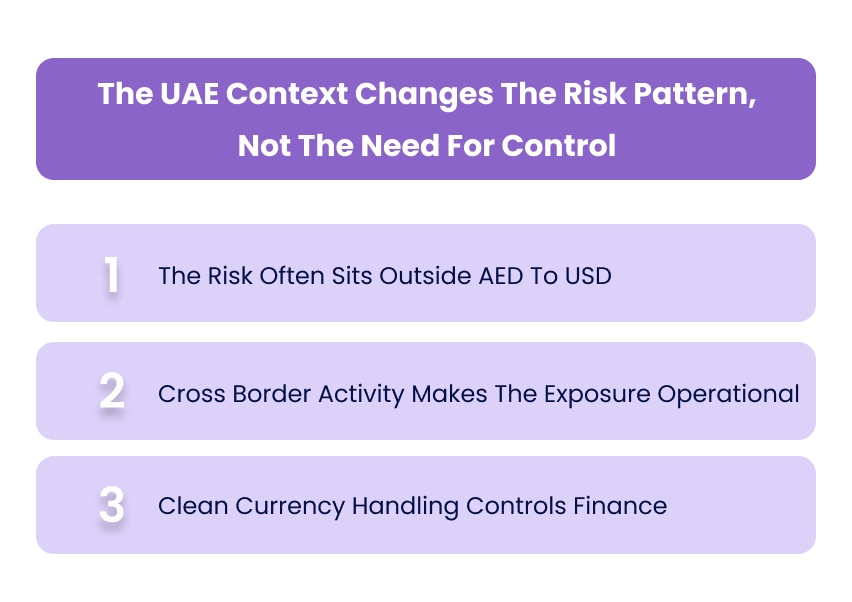
The dirham’s stability against the US dollar reduces one category of volatility, but that does not eliminate exposure tied to non-USD supplier contracts, overseas collections, imported cost bases, or foreign currency reporting positions. For many UAE businesses, the real issue is not whether FX risk exists. It is whether finance can see it early enough and explain it clearly enough.
The Risk Often Sits Outside AED To USD
Many businesses assume the peg removes most of the concern. In reality, the sharper exposure often sits in currencies such as:
- Euro
- Pound sterling
- Indian rupee
- Chinese yuan
- Other supplier and trading currencies tied to imports or regional operations
That changes the control focus. The question becomes less about broad market volatility and more about where the business has actual commercial dependency.
Cross Border Activity Makes The Exposure Operational
For UAE businesses, foreign currency exposure often builds through normal operating patterns rather than exceptional treasury activity.
This is especially relevant for:
- Importers and distributors
- Regional holding structures
- Businesses with overseas vendors
- Firms with foreign currency customer contracts
- Companies managing distributed international spend
In these businesses, exchange exposure is embedded in day-to-day finance operations, not ring-fenced in a specialist function.
Clean Currency Handling Still Matters For Finance Control
Even where the exposure is not severe enough to require formal hedging, it still needs clean handling. Finance needs to know which transactions are exposed, when they settle, what assumptions are built into forecasts, and how much variance can be tolerated before escalation is required.
Without that, exchange exposure stops being just a market variable and becomes a control weakness.
Also Read: Cash Management Control System UAE
A Practical Framework For Controlling Exchange Exposure
Most businesses do not need a complex treasury setup to improve exchange exposure control. What they need is a clearer operating framework: one that shows where exposure sits, which positions are material, and when finance needs to intervene before rate movement starts distorting cash or margin.
The goal is not to eliminate every currency-related movement. The goal is to stop avoidable volatility from building through weak timing, poor visibility, or inconsistent ownership.
Map Exposure By Currency
The first step is to move away from treating FX as one broad issue. Finance needs a currency-by-currency view of where exposure actually sits across the business.
That usually means bringing together:
- Supplier payables
- Customer receivables
- Recurring foreign-currency spend
- Intercompany balances
- Committed but not yet settled transactions
This is often where the real picture becomes visible. A business may assume it has broad foreign-currency activity, only to find that most of its exposure is concentrated in two or three currencies.
Separate Short Term Exposure From Structural Exposure
A supplier invoice due next week should not be managed in the same way as a long-term sourcing issue. These are different types of problems, with different finance responses.
Short-term exposure usually sits around settlement timing. Structural exposure tends to sit inside pricing models, supplier concentration, or recurring cost dependence on a particular currency. Treating both in the same way often leads to superficial control.
Reduce Open Time Windows
One of the simplest control improvements is to reduce the gap between commitment and settlement. The longer that window remains open, the more time there is for currency movement to affect the final outcome.
Finance can reduce that window by tightening:
- Approval turnaround
- Invoice processing discipline
- Payment scheduling
- Contract-to-settlement coordination
This does not remove exposure entirely, but it often reduces the amount of volatility the business absorbs unnecessarily.
Use Natural Hedges Before Financial Hedges
Where possible, businesses should first look at whether inflows and outflows in the same currency can offset each other. That is often a cleaner starting point than moving straight into formal hedging.
For example, a business collecting revenue in a foreign currency may be able to match part of that position against supplier obligations in the same currency. That does not solve every exposure issue, but it can reduce the size of the open position finance needs to manage.
Define Escalation Thresholds
Not every foreign-currency transaction deserves the same level of attention. The stronger approach is to set thresholds that determine when exposure becomes material enough to review, escalate, or hedge.
Those thresholds usually depend on:
- Transaction size
- Currency concentration
- Settlement timing
- Margin sensitivity
- Forecast impact
Without this, finance ends up responding inconsistently, with some positions ignored and others over-managed.
Assign Ownership And Review Cadence
Exchange exposure becomes harder to control when ownership sits between teams. Procurement may create the commitment, accounts payable may settle it, FP&A may see the variance, and treasury may only hear about the issue after the fact.
A workable framework needs clear ownership around:
- Exposure monitoring
- Exception review
- Escalation decisions
- Hedge approval, where relevant
- Reporting cadence
That is what turns exchange exposure from a reactive finance issue into a controlled operating process.
Related: Control Account Reconciliation
The Operating Signals That Usually Mean Control Is Weak
Finance teams do not always discover exchange exposure through formal risk reviews. More often, they discover it because the same financial symptoms keep reappearing across reporting cycles.
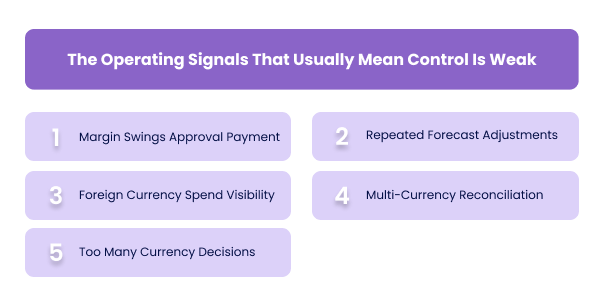
These symptoms matter because they suggest the business is not just experiencing currency movement. It is absorbing that movement without enough structure around visibility, timing, or decision-making.
Margin Swings Between Approval And Payment
A purchase may be commercially sound when approved, but the final settled cost lands noticeably higher. If this happens repeatedly, the issue is usually not procurement alone. It points to a control gap between commitment, settlement timing, and currency monitoring.
Repeated Forecast Adjustments
Rolling forecasts lose credibility when finance keeps revising expected cash outcomes for FX-related reasons. Some adjustment is normal. Repeated unexplained adjustment usually means the business has not clearly identified which foreign-currency positions deserve active review.
Foreign Currency Spend With No Consolidated View
This is common in growing businesses. Teams spend across cards, subscriptions, travel, digital platforms, and overseas vendors, but finance does not have a single timely view of where foreign-currency exposure is accumulating.
That fragmentation makes response slower and month-end interpretation harder.
Reconciliation Delays Around Multi Currency Activity
Where foreign-currency transactions are spread across systems, reconciliations usually take longer. Settlement values do not line up neatly with expected values, small differences start accumulating, and finance spends more time explaining movement than controlling it.
Too Many Ad Hoc Currency Decisions
A business with strong control does not decide invoice currency, payment timing, or escalation logic differently every time. If those decisions are largely ad hoc, the business is managing exchange exposure by habit rather than by policy.
These are usually the signals that appear before finance explicitly labels the issue as exchange exposure. By the time they become visible in reporting, the underlying problem has often been present for some time.
Also Read: Account Reconciliation Importance Steps
Why Exchange Exposure Is Also A Visibility Problem
Exchange exposure is often discussed as though it sits only in the movement of rates. In practice, it often becomes more difficult because the underlying spend and settlement activity is fragmented across the business.
Finance cannot manage what it cannot see in time. When foreign-currency transactions sit across different cards, teams, vendor relationships, approval paths, and systems, the problem is no longer just exposure. The problem is incomplete visibility into where that exposure is building and how quickly it is becoming material.
That visibility gap usually shows up in three ways.
Currency Activity Is Scattered Across Systems
Foreign-currency transactions often sit across procurement tools, banking portals, card statements, expense workflows, and the ledger. When those systems are not tightly connected, finance ends up seeing the full picture too late.
The Operational Context Gets Lost
A settlement amount alone does not explain the risk. Finance also needs to know what the transaction relates to, who approved it, when it was committed, and whether the currency position was expected or avoidable.
Without that context, the business sees currency effects in reporting but cannot easily trace them back to the operating decision that created them.
Small Transactions Become Material In Aggregate
This is one of the most underestimated issues. Large supplier contracts usually get attention. Smaller foreign-currency transactions often do not. Yet those smaller transactions can accumulate into a position that materially affects spend quality, reconciliation effort, and forecast accuracy.
That is why exchange exposure often connects directly to broader finance control themes such as spend visibility, approval discipline, and cleaner transaction capture.
Related: Understanding Spend Visibility Business Benefits
How Alaan Helps Finance Teams Control Foreign Currency Spend Before It Turns Into Reporting Noise
Exchange exposure is often discussed as though it begins at the moment of payment. In practice, a large part of the problem starts earlier, when foreign-currency spending is approved, distributed across teams, documented inconsistently, or settled without enough visibility into the wider position.
At Alaan, we operate in that control layer. We are not an accounting software or a treasury platform. We help finance teams manage company spend with stronger visibility, policy enforcement, and cleaner reconciliation, so foreign-currency activity is easier to identify and control before it becomes avoidable variance.
- Corporate Cards With Spend Controls
At Alaan, we provide corporate cards with configurable limits and vendor restrictions, helping finance teams keep foreign-currency spend within approved boundaries rather than reviewing it only after the transaction is complete. - Structured Approval Workflows Before Spend Happens
Our approval workflows can be configured around company policy, so finance teams can control how expenses move through review before money leaves the business. That matters when foreign-currency spending needs tighter scrutiny because timing and settlement values can change the final cost. - Real-Time Visibility Into Company Spend
We give teams centralised visibility into company expenses as they happen. That makes it easier to spot where foreign-currency activity is building across cards, teams, and vendors instead of waiting until month-end to piece it together. - Receipt And Invoice Capture Linked To Transactions
Receipts can be uploaded through the app, Chrome extension, or email, then matched against transaction data. This gives finance teams clearer documentation around overseas spend and reduces the friction of tracing foreign-currency transactions back to their source. - AI-Assisted Verification And Duplicate Detection
Alaan Intelligence checks receipt details against transaction data, flags discrepancies, and detects duplicates. That helps reduce manual checking and improves control where multi-currency spend would otherwise create extra reconciliation noise. - Cleaner Accounting Sync And Faster Reconciliation
We integrate with systems such as Xero, QuickBooks, Oracle NetSuite, and Microsoft Dynamics, with real-time syncing and automated categorisation support. That helps finance teams close faster and reduce the manual effort of reconciling distributed foreign-currency spend.

In practice, this means finance does not have to wait for month-end to understand where foreign-currency spend has accumulated. The transactions are more visible, the approvals are clearer, and the reconciliation trail is easier to follow.
Conclusion
Exchange exposure becomes harder to manage when it is treated as a market issue alone. In most businesses, it builds through routine decisions around procurement, collections, approvals, distributed spend, and settlement timing. That is why stronger FX control usually starts with better operating discipline, not just better treasury reaction.
The businesses that handle it well do not try to eliminate every currency movement. They focus on visibility, materiality, and process. They identify where foreign-currency risk is entering the business, reduce avoidable timing gaps, and make sure the underlying transactions are easier to monitor and reconcile.
And when foreign-currency spend is distributed across teams, cards, subscriptions, and supplier payments, that control layer matters even more. At Alaan, we help finance teams keep spending visible, governed, and easier to reconcile across the workflows where exchange exposure often begins. Book a demo Today!
FAQs
1. How Often Should A Business Review Exchange Exposure?
That depends on how frequently foreign currency commitments are created and how material they are to cash flow or margin. Businesses with recurring cross-border activity usually need more than a month-end view. A periodic review tied to payment cycles, forecast updates, or treasury checkpoints is often more useful than waiting for reporting close.
2. Who Should Own Exchange Exposure Inside The Business?
Ownership is rarely effective when it sits with one team in isolation. Procurement, accounts payable, FP&A, finance control, and treasury may all influence the final outcome. In practice, one finance owner usually needs to coordinate visibility and escalation, while specific teams remain accountable for the transactions that create the exposure.
3. Does Every Foreign Currency Transaction Need Hedging?
No. Treating every transaction as a hedging candidate usually adds complexity without improving control. The more practical approach is to define thresholds based on value, timing, predictability, and margin sensitivity, then escalate only the exposures that are material enough to warrant action.
4. Can Exchange Exposure Affect Decision-Making Even If The Final FX Impact Looks Small?
Yes. Even when the eventual financial effect is limited, weak visibility over foreign currency commitments can slow approvals, distort planning assumptions, and create unnecessary friction in reporting or reconciliation. The control issue can matter before the accounting impact becomes material.
5. What Makes Exchange Exposure Harder To Manage In Growing Businesses?
Growth usually increases the number of currencies, vendors, teams, systems, and approval paths involved. That makes exposure more fragmented and harder to spot early. As a result, the risk often becomes less about one large FX position and more about multiple smaller positions building across the business without a consolidated view.