.avif)


Cash flow pressure is a live issue for UAE businesses. Atradius’ 2025 UAE B2B payment practices report found that overdue invoices affect 58% of B2B sales, with payment delays often linked to administrative inefficiencies in customer payment processes.
This is why vague goals such as “improve cash flow” are not enough. Finance teams need specific targets that show whether cash is being collected on time, whether supplier payments are being timed properly, and whether the business has enough liquidity to manage short-term obligations.
Cash flow targets turn cash management into a measurable discipline. They help businesses define minimum cash reserves, collection expectations, payment timing, and forecast accuracy so that decisions are based on thresholds rather than urgency.
In this blog, we will look at what cash flow targets actually mean in practice, the key targets that matter most, and how businesses can improve cash flow management in a way that strengthens control rather than creating short-term fixes.
TL;DR / Key Takeaways
- Cash flow targets turn broad liquidity goals into measurable operating thresholds for reserves, collections, payables, and forecasting.
- A single headline cash target is not enough because cash pressure can come from delayed receivables, early payments, weak forecasting, or excess inventory.
- Strong targets should reflect the business model, fixed outflows, payment cycles, supplier terms, and historical cash movement.
- Most cash flow problems are timing problems before they become liquidity problems.
- Finance teams improve cash control when targets are supported by real-time spend visibility, disciplined approvals, and accurate reporting.
What Cash Flow Targets Mean In Practice
Cash flow targets are the measurable thresholds a business sets to maintain liquidity, manage timing, and ensure operational stability. They are not abstract financial goals. They are specific benchmarks that guide how cash is collected, retained, and deployed across the business.
For a finance leader, these targets typically sit across multiple areas rather than one single number. A company may define how many months of operating expenses should be held in cash, how quickly customers should pay, how long supplier payments can be deferred without damaging relationships, and how accurate short-term cash forecasts need to be.
These targets matter because they translate financial health into day-to-day operating decisions. When they are clearly defined, teams know how to prioritise collections, when to release payments, and how to manage spend. When they are not, cash flow becomes reactive and harder to control.
Also Read: Cash Flow Operating Activities Guide
Why Generic Cash Flow Goals Usually Fail
Most businesses start with broad goals such as “improve cash flow” or “maintain a healthy balance.” These sound directionally correct but rarely lead to better outcomes because they do not define what needs to change operationally.
A 2025 QuickBooks report found that 56% of surveyed small businesses were owed money from unpaid invoices, averaging USD 17,500 per business, showing how quickly receivables can turn into working capital pressure.
A cash flow goal becomes meaningful only when it is broken into specific targets. Without that breakdown, several issues tend to appear:
- No clear baseline to measure improvement
- No defined ownership across teams
- No distinction between structural issues and timing delays
- No visibility into which part of the cash cycle is underperforming

As a result, finance teams often focus on symptoms rather than causes. Collections may be pushed harder in one month, payments delayed in another, but there is no consistent framework guiding those decisions.
The Cash Flow Targets That Matter Most
Different businesses may prioritise different targets, but a small set of core metrics usually defines whether cash flow is stable or under pressure. These targets work together rather than in isolation.

1. Minimum Cash Buffer
A minimum cash buffer defines how much liquidity the business should maintain at any given time. This is typically linked to fixed monthly outflows such as salaries, rent, vendor payments, and essential operating costs.
A clearly defined buffer helps the business absorb short-term disruptions without forcing reactive decisions such as delaying critical payments or drawing emergency funding.
2. Receivables Collection Target
This target focuses on how quickly the business converts invoices into cash. It is often measured through average collection time or days sales outstanding.
Slow collections are one of the most common reasons for cash flow pressure. Even when revenue is strong, delayed inflows can create liquidity gaps that affect day-to-day operations.
3. Payables Timing Target
Payables targets define how the business manages outgoing payments to suppliers. The goal is to maintain discipline without damaging supplier relationships or missing agreed terms.
A balanced approach ensures that payments are neither rushed unnecessarily nor delayed in a way that affects credibility or supply continuity.
4. Inventory Conversion Target
For businesses that hold inventory, cash is often tied up in stock. This target measures how quickly inventory moves through the business and converts back into cash.
Poor inventory turnover can create hidden cash flow constraints, even when sales volumes appear healthy.
5. Operating Cash Flow Consistency
This target focuses on how reliably the business generates cash from its core operations over time. A business that fluctuates heavily month to month may appear healthy on average but still face periodic liquidity stress.
Consistency matters more than occasional spikes because it supports predictable planning and smoother operations.
6. Forecast Accuracy Target
Forecast accuracy is often overlooked but is critical for managing cash effectively. A business may have strong collections and controlled spend, but if forecasts are unreliable, decision-making becomes reactive.
Accurate forecasting allows finance teams to anticipate shortfalls, plan payments, and maintain confidence in cash position.
Related:
How To Set Cash Flow Targets Without Guesswork
Setting cash flow targets is not about choosing ideal numbers. It is about grounding those numbers in how the business actually operates. Targets that are not tied to real payment cycles, revenue timing, and cost structure tend to be ignored or adjusted too frequently to be useful.
A structured approach helps ensure that targets remain realistic, measurable, and actionable.
1. Start With Fixed Outflows And Payment Commitments
The first step is to understand how much cash the business needs to operate without disruption. This includes salaries, rent, vendor payments, debt obligations, and any recurring costs that cannot be deferred.
This baseline determines the minimum liquidity requirement and directly informs the cash buffer target.
2. Review Historical Cash Movement Patterns
Past data provides a clearer picture of how cash actually moves through the business. Collection timelines, payment delays, seasonal fluctuations, and one-off events all affect how targets should be set.
Looking at historical patterns helps avoid setting targets that look correct in theory but do not reflect operational reality.
3. Separate Timing Issues From Structural Issues
Not all cash flow problems are the same. Some are driven by timing gaps, such as delayed collections or early payments. Others are structural, such as low margins or high fixed costs.
Targets should reflect this distinction. Improving timing can help stabilise cash in the short term, but structural issues require deeper changes.
4. Adjust Targets Based On Business Model
Different business models require different cash flow structures. A services business may prioritise faster collections, while a trading or manufacturing business may need tighter control over inventory and supplier payments.
Setting uniform targets across all business types leads to unrealistic expectations and weak decision-making.
5. Assign Ownership Across Functions
Cash flow is not managed by finance alone. Sales teams influence collections, procurement affects payment timing, and operations impact inventory levels.
Targets should be assigned to the functions that influence them. This ensures that cash flow management becomes a shared responsibility rather than a finance-only concern.
How To Improve Your Cash Flow Management When Targets Are Missed
When cash flow targets are not met, the response should be structured rather than reactive. The focus should be on identifying which part of the cycle is underperforming and addressing that specific issue.

1. Tighten Invoicing And Collections Discipline
Delays in invoicing or inconsistent follow-up on receivables are common causes of cash flow pressure. Improving invoicing speed and collection processes can reduce the time it takes for revenue to convert into cash.
2. Reduce Approval Delays Around Revenue And Spend
Internal delays can affect both inflows and outflows. Slow approvals may delay invoicing, while unclear approval processes can lead to unplanned spending. Streamlining approvals improves both visibility and timing.
3. Rework Payment Terms Carefully
Adjusting payment terms with customers or suppliers can improve cash positioning, but it needs to be handled carefully. Aggressive changes may affect relationships or create operational risk.
4. Identify And Eliminate Non Essential Spend
Reducing unnecessary expenses can provide immediate relief, but the focus should remain on waste rather than critical business functions. Cutting essential spend can weaken long-term performance.
5. Improve Short Term Forecasting Discipline
Better short-term forecasting allows finance teams to anticipate gaps and plan accordingly. Even small improvements in forecast accuracy can reduce the need for last-minute adjustments.
Also Read:
- How To Solve Cash Flow Issues In Business Practical Strategies In UAE Businesses
- Effective Ways To Reduce Operating Expenses
How To Improve Cash Flow Of A Company Without Damaging Operations
Improving cash flow should not come at the cost of operational stability. Some short-term actions can improve liquidity temporarily but create longer-term risks if applied without balance.
For example, delaying supplier payments beyond agreed terms may improve cash position in the short term, but it can damage supplier relationships or affect supply continuity. Similarly, reducing inventory too aggressively can disrupt operations if demand remains steady.
Sustainable improvement comes from strengthening processes rather than forcing short-term adjustments. Businesses that maintain discipline around approvals, collections, documentation, and spend visibility tend to see more stable and predictable cash flow over time.
The goal is not just to increase cash availability. It is to ensure that cash moves through the business in a controlled and predictable way.
Common Mistakes When Setting Cash Flow Targets
Cash flow targets are only useful when they are defined and applied correctly. Many businesses set targets that appear reasonable but fail to guide actual decision-making.
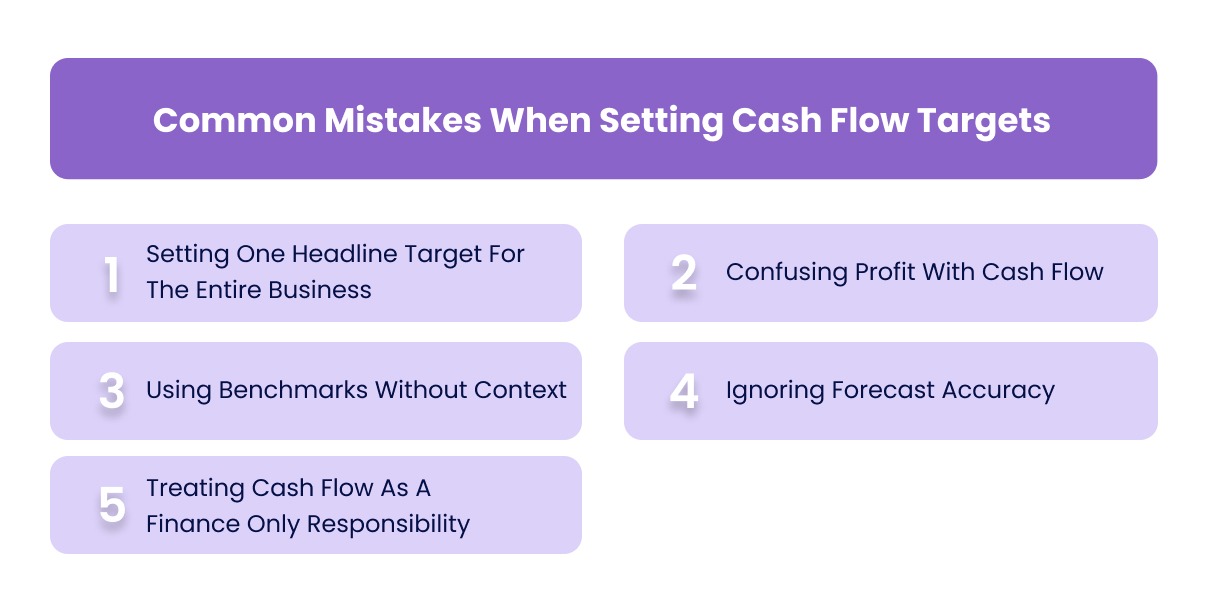
1. Setting One Headline Target For The Entire Business
Relying on a single number does not capture the complexity of cash flow. Different aspects of the business require different targets, and combining them into one metric reduces clarity.
2. Confusing Profit With Cash Flow
Profitability does not guarantee liquidity. Businesses can report strong profits while still facing cash shortages due to timing differences between inflows and outflows.
3. Using Benchmarks Without Context
Industry benchmarks can provide guidance, but they do not always reflect the realities of a specific business. Targets should be adapted to the company’s size, model, and operating conditions.
4. Ignoring Forecast Accuracy
Without reliable forecasting, even well-defined targets become difficult to manage. Forecast accuracy is a critical component of cash flow control.
5. Treating Cash Flow As A Finance Only Responsibility
Cash flow is influenced by multiple functions. Limiting responsibility to finance reduces accountability and weakens execution across the business.
How Alaan Helps Finance Teams Stay Closer To Cash Reality
Cash flow targets are only effective when supported by accurate, real-time visibility into how money moves through the business. Delays in tracking expenses, fragmented approvals, and incomplete documentation make it harder to understand the true cash position.
At Alaan, we help finance teams stay closer to that reality by improving how spend is controlled, tracked, and recorded.
- Corporate Cards With Built In Spend Controls
We enable businesses to issue corporate cards with defined limits and restrictions, helping prevent unplanned or uncontrolled outflows. - Structured Approval Workflows Before Spend Happens
Expenses can be routed through clear approval paths, ensuring that spending decisions are reviewed before cash leaves the business. - Real Time Visibility Into Business Expenses
Finance teams can monitor spending as it happens, making it easier to track cash movement without waiting for month-end reports. - Centralised Receipt And Invoice Capture
All supporting documents are linked directly to transactions, improving accuracy and reducing gaps in financial records. - Seamless Accounting Integration
With integrations into Xero, QuickBooks, NetSuite, and Microsoft Dynamics, expense data flows into accounting systems without manual delays.

This level of visibility and control helps businesses align day-to-day spending with their cash flow targets, rather than adjusting targets after the fact.
Related:
- Modern Expense Management Guide
- Track And Manage Business Expenses
- Understanding Spend Visibility Business Benefits
Conclusion
Cash flow targets bring structure to how a business manages liquidity. Instead of relying on general goals, they define clear expectations for cash reserves, collections, payments, and forecasting accuracy.
For finance leaders, the focus should be on setting targets that reflect real operating conditions and ensuring that those targets are supported by disciplined processes. When approvals, spend visibility, and documentation are aligned, cash flow becomes more predictable and easier to manage.
If you want to improve how your business tracks and controls cash movement, you can explore how Alaan helps finance teams maintain visibility, enforce approvals, and keep financial data accurate from transaction to reconciliation. Book a Demo Today!